Showing posts with label craft beer. Show all posts

Thursday, September 5, 2013

Predicting Mash Efficiency in an "Igloo-Style" Homebrew System, Part 2

As follow-up to the last blog entry, I’ve updated my mash efficiency prediction model with 6 more batches of beer, doubling the sample size. Variables were described in the previous article, and I also added a new variable called "Experience," which is really just the batch number on my new system. All input variables and the resulting mash efficiencies are shown in Table 1.

I analyzed the data using the same ordinary least squares regression (OLS) technique described in Part 1, but this time the resulting model was highly predictive of mash efficiency. OLS results are shown in Table 2, where it's seen that the most significant variable by far is Experience on the new system, as the magnitude of its t-stat is much larger than any of the others. Grain Crush is also significant, and Average Mash Temperature is approaching statistical significance. (As a rule of thumb, a t-stat whose magnitude is 1.96 or greater indicates statistical significance.)


Using the coefficients from Table 2, I built a mathematical model for mash efficiency,
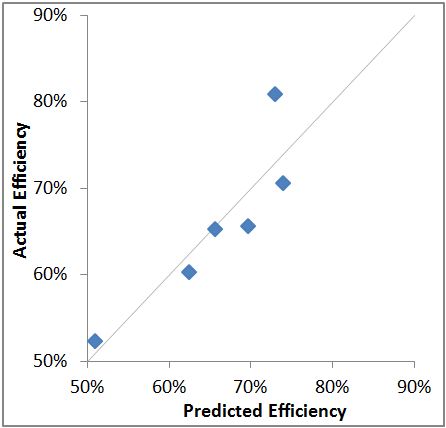
and the model's predicted mash efficiencies are plotted against the actual mash efficiencies in Figure 1. In a perfect model all points would lie directly on the diagonal line, and this model's points, shown by blue diamonds, are very close to that line, providing visual support that the model is very predictive. In fact, the adjusted R-squared of the model is 0.89, which is outstanding and essentially means that the model accounts for 89% of the real-world variation.

My conclusions from this experiment are as follows:

1. It took a lot more batches than expected to start achieving consistent mash efficiencies. With the exception of the sixth batch on my new system, where I presumably got lucky, it took a surprising ten batches before results started looking repeatable. I don't know exactly what caused my learning curve, but I presume it has to do with sparging method, transfer times, stirring technique, and other "brewing moves."

2. When starting to brew on a new system, use the same mash thickness, mash temperature, and mash duration every time until you start to achieve consistent results. Until then, the effects of these variables will be imperceptible within the "noise" anyway.

3. Much of the brewing science and theory homebrewers consume is applicable only after you're able to achieve consistent mash efficiencies. On my last three batches I've finally averaged about 87% efficiency with an overall variation of less than 5%. If I can keep this the same for the next three or four batches, I may start to experiment with mash thickness, temperature, and duration again.

Overall, many homebrewers like myself enjoy the science aspect of this hobby, and can sometimes focus a bit too much on recording numbers out to third decimal place. But until your process is controlled enough to achieve consistent mash efficiencies, none of this really matters. Such control is harder to achieve than expected when using an "igloo-style" homebrew system, but keep aiming for it!

Monday, February 4, 2013

Predicting Mash Efficiency in an "Igloo-Style" Homebrew System, Part 1

Like most homebrewers who make the leap to all-grain brewing, I quickly learned that my 5-gallon sized partial-mash equipment just wasn't going to cut it for all-grain brewing; even when making 5 gallon batches of beer. For all but the thickest mashes, more volume is needed once you get beyond 13 or 14 pounds in the grain bill.

Therefore I assembled a 10-gallon system (pictured) by purchasing a couple of Igloo coolers from Home Depot, boring holes in them, and installing some good quality ball valves, fittings, and washers from McMaster Carr supply company. I also added a nice, stainless steel false-bottom to the mash tun. The system is not elaborate, but that's the point. It's simple, inexpensive, easy to clean, and most importantly, it works. I think of it as elegant.

Once I started brewing with my new system, one of the first things I needed to determine was my mash efficiency. I did this by making a reasonable guess for the first batch, then simply started brewing and taking measurements. After several batches I realized there was a lot of variation... efficiency ranged from about 60% to 80% across several batches. Fortunately I was meticulous about making measurements and collecting data, and I wondered if I could develop a reasonable prediction model for the efficiency of any given batch. The remainder of this article will explain my prediction model, and any homebrewer with an above average understanding of math or statistics can build a similar model.

The dependent variable in my model is obviously mash efficiency, expressed as the actual extract divided by the potential extract. If you use brewing software (such as Bradley Smith's fantastic and affordable BeerSmith) then all the better because the software calculates the actual mash efficiency based on your inputs. The four independent variables in my model are mash duration (minutes), mash thickness (quarts of water per pound of grain), mash temperature (degrees F), and mash pH. Mash duration is fairly self-explanatory in that longer durations lead to higher mash efficiencies. Mash thickness is a little more complicated. Although the rule of thumb is that thinner mashes have higher efficiency, the enzymes are also less "protected" and more sensitive to variations in temperature and pH, which can actually have a negative effect. The same can be said for mash temperature. Finally a mash pH of 5.3 is ideal, and efficiency drops as pH goes either up or down from this value.

Making good measurements in an igloo-style system can be a little more involved than it sounds since it is neither temperature controlled or recirculating. I have found that mash temperature varies within the mash tun itself, and to a lesser extent over the mash duration. Therefore I typically measure the mash temperature every 15 minutes using a K-type thermocouple, and for each measurement take the average of three data points (near the bottom, center, and top of the mash). These 15-minute measurements are then averaged to get the mash temperature. I use a similar approach for pH using a quality, temperature-compensating pH meter, although a single data point for each 15-minute measurement suffices as pH does not seem to vary within the mash tun.

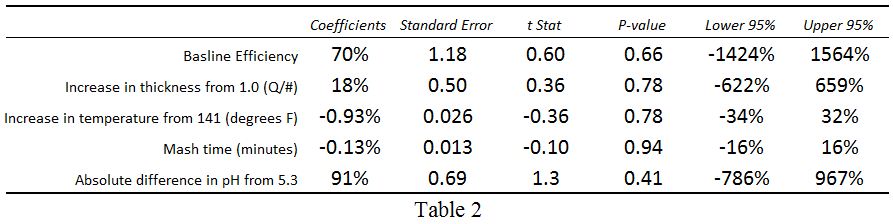
Armed with some data (Table 1), I know that four variables (n) require a sample size of at least five (n+1),  so after brewing six batches on my new system (one more than required) I developed an initial prediction model using ordinary least squares regression. The results from this model are shown in Table 2, and the resulting equation is:


Predicted Mash Efficiency = 70% + [18% x (Mash Thickness - 1)] + [-0.93% x (Mash Temperature - 141°F)]
                       + (-0.13% x mash Duration) + (91% x |Mash pH - 5.3|)

The actual versus predicted results are shown graphically in Figure 1, and they look pretty good. But upon closer look, one notices right away that a couple of the coefficients don't really make sense. For example, mash efficiency should increase with duration, but the coefficient is negative. Efficiency should decrease as pH varies from 5.3, but the coefficient is positive. It turns out that none of the coefficients are statistically significant, as evidenced by their t-statistics and lower & upper 95% intervals in Table 2. In other words, the model is not very good, and the coefficients are not meaningful.

There are three possible explanations for the poor model: 1) There is just not enough data yet to understand the impact of each variable; 2) Most variation is caused by something other than the variables in the model; or 3) The variables are not independent; rather, mash efficiency is best predicted by some interaction between the variables. I am leaning toward 1 and 3 since I built the model from the bare minimum amount of data required, and because it's well-established that there is a complicated relationship between mash thickness and the other variables, as briefly explained above. I think explanation 2 is unlikely since the only other possible variables are grain crush size and potential extract values falling short of what's being used in the mash efficiency calculation. Regarding crush size, all my grains except for one batch were crushed on the same mill at the same setting. And I have no choice but to assume that the potential extract values published by the maltster are fairly accurate. 

Although my initial attempt to develop a prediction model for mash efficiency of my brewing system was unsuccessful, this exercise gave me insight into how much variation there can be using an "igloo-style" brewing system. I also developed some appreciation for how well commercial brewers must control their processes to get consistent results. I'll keep taking data and updating the model periodically, and I'll keep you posted if I come up with a prediction equation that becomes meaningful. Until then, I encourage all advanced homebrewers to take good data with quality instruments, experiment, and develop a deeper understanding of your own system and process. For me, that is part of the joy of this hobby.

Monday, October 15, 2012

Has the Great American Beer Festival Gotten Too Big?

The coming of autumn means cooler temperatures, turning of the leaves, and for craft beer enthusiasts, it means the Great American Beer Festival (GABF). Those of us who live in Denver have the added bonus of the festival being held here every year since its inception in the late eighties. (Technically, I think the first couple were held in Boulder, but I'm splitting hairs.)

GABF is produced by the Brewer's Association (BA). According to BA, the primary purpose of GABF "is to educate the consumer about the quality and diversity in beer-styles and breweries that exist across the United States." Impressively, more than 500 of BA's 1,400 brewery members were in attendance this year, so thumbs up for diversity of beers! On the other hand, with 49,000 attendees opportunities to "educate" the consumer were limited at best.

Tickets to this year's GABF sold out in minutes. Even those of us eligible for the BA members-only  presale were in disbelief how quickly tickets were swiped up, and I was only able to score tickets for the Friday night session... happy hour. Most of the festival floor was shoulder-to-shoulder, and although the organizers did an amazing job of ushering so many people through so quickly, the crowd was just overwhelming.

For serious home brewers, intimacy and the ability to interact with professional brewers has been one of the GABF hallmarks. Because of the crowds, that intimacy and ability was gone this year.  It's nearly impossible to have a conversation with a brewer about aroma-hopping with Simcoe instead of Citra when there are twenty people lined up behind you waiting for a sample of beer. Most breweries are just rushing people through, and that's understandable.

My suggestions for improving GABF in the future are:
1. Hold more BA and AHA members-only events. BA and AHA members are some of the biggest proponents of craft beer. We tell everybody we know about great new beers, beer-styles, hops, and breweries. I think there would be a positive trickle down affect from giving us a little more access without the crowds.
2. Establish an education track in which serious home brewers and craft beer enthusiasts can learn more about brewing, ingredients, and the business of brewing. Sessions could be limited in size and taught by professional brewers or other respected people in the craft beer industry. We would be willing to pay more for such an opportunity.

The size of GABF this year is simply a reflection of the growing popularity of craft beer, and that's good. But in terms of educating the consumer via intimacy and direct interaction with brewers, I think the GABF has gotten too big. Until some new ideas are implemented, like the ones I've suggested above, I'll be skipping next year's GABF and instead going to the smaller and more intimate events and tastings that happen around town in the weeks leading up to the festival.

Thursday, June 14, 2012

Beer Labels as Fine Art? Occasionally.

While recently enjoying a Sierra Nevada Ruthless Rye, I decided that I liked the beer label more than the beer itself.  Don’t get me wrong – I think this beer is good; it’s just not great.  It’s very restrained for a “rye-PA,” so I admire that Sierra Nevada is not joining the malt and hops one-upmanship game that so many craft brewers are playing.  But overall I found it to be, well… meh.  Apparently this is a replacement for their Glissade spring bock, which is a little surprising to me, as this rye ale just screams autumn.  As does its label.

And the label is striking!  Done in a style reminiscent of high-end graphic novels, the first thing you’re drawn to is the color scheme.  The hues are analogous enough to be soothing, but just far enough apart to throw you off a little and create an uneasy feeling.  The woman is haunting yet beautiful, like Patrick Nagel meets the witches from MacBeth.  Details, like the ominous clouds and strands of hair in the woman’s face, complete the picture.  The overall impression is chilling, hypnotic, and mysterious.


It turns out the artist is rock and roll illustrator Ken Taylor.  Best known for his album covers and concert posters, he dabbles in other areas too.  Somebody at Sierra Nevada must be a fan, so now he can add beer labels to that list.  Perhaps he’s a craft beer lover too?  Check out his portfolio.

Most beer labels have an illustration of an animal, landscape, person, or some other scene that matches the beer’s name.  It is usually competent and professional, but unmemorable.  Those who try to make the artwork take center-stage often go over the top in my opinion, producing art that’s better suited for the next Motorhead or Insane Clown Posse album cover.  (Sorry Coney Island and Ska Brewing.)  To me, the best beer labels are ones like those shown below.  The monochromatic, accented color schemes and easy to read fonts make beautiful, elegant designs.  But they are not art.  And that’s just fine, because it’s about what’s inside the bottle.


But Sierra Nevada may have changed the rules with their latest label.  Look at the crowded craft beer section in any well-stocked liquor store, and you’ll notice that Ruthless Rye really stands out.  That's the whole point of packaging.  You are drawn to it because it’s unique; it’s fancy, but it’s classy.  It’s a Bellagio in a sea of tacky Las Vegas strip hotels.

As the craft beer scene becomes more crowded, small brewers are struggling to come up with unique beer names and packaging that attracts attention.  I have a hunch that some of these brewers will follow Sierra Nevada’s example and start employing established artists.  For us beer-geeks who love art and design, this will be a nice bonus!

Please comment and share some your favorite beer label designs, and check out these links for more on this topic: The Pour Curator, and  15 Beer Labels we Love.